
Praying with the Noise
Construction, distraction, and learning to pray with the city rather than against it

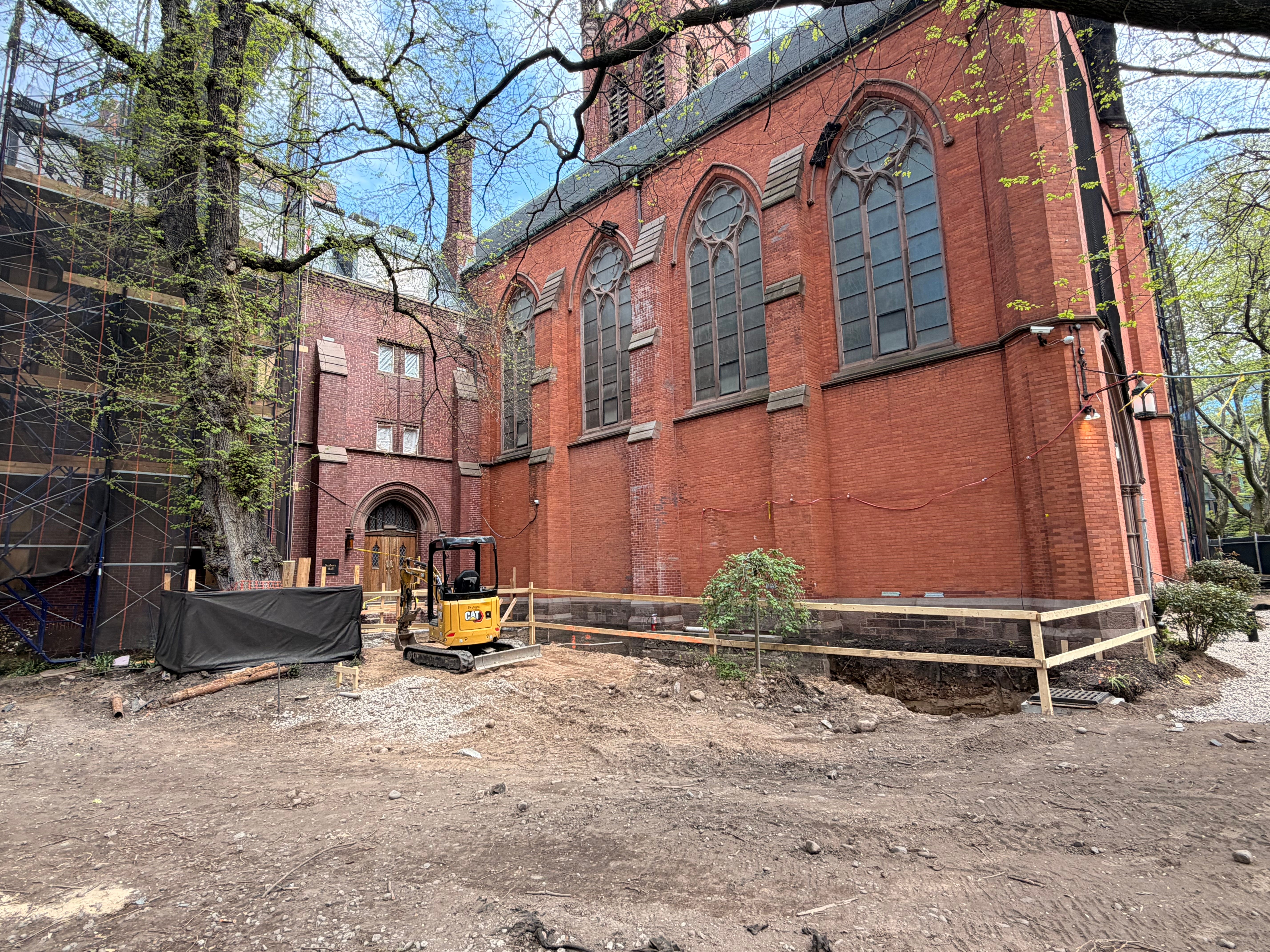
Construction to the west of the Chapel of the Good Shepherd
The Chapel of the Good Shepherd sits at the spiritual and geographic center of The General Theological Seminary. Alumni returning to the Close almost invariably want to visit the Chapel first (usually followed closely by Hoffman Refectory). And whenever I speak with alumni about Vanderbilt’s renovation work on the Close, the question I hear more than any other is some version of: “But what’s happening to the Chapel?”
That question itself says something important.
For generations of students, the rhythm of common prayer in the Chapel has shaped the very texture of Seminary life. As Dean of the Chapel, these intensive weeks each year are both the busiest and most joyful part of my vocation: planning and leading three services a day, preparing students to officiate, hearing the daily cadence of psalms and canticles settle once again into the bricks of the building.
Most years, the Chapel carries a kind of stillness before the offices begin. Early in the morning especially, there is a deep quiet to the place. Students enter softly, or — at the beginning of an intensive week — with the joyful exuberance of friends seeing one another again after months apart online. Candles are lit. Books are arranged. Sunlight filters through the windows. We often describe the Close as “an oasis in the heart of the city,” and the architecture itself can feel like an aid to prayer: a place that helps us become attentive, grounded, and present to God.

This year has been rather different.
The New York weather decided abruptly that late spring was over and summer had arrived, vaulting from fifty degrees to ninety-five in the space of a few days. Meanwhile, Vanderbilt’s renovation work continues all around us. Heavy machinery moves rubble, cement, and sod across the campus. Hammer drills shake the Chapel walls during the psalms. Backup beepers punctuate the collects. And instead of incense smoke catching the light, it is often construction dust floating through the air and settling gently on every surface.
Now, I should confess that I am not naturally gifted at handling distraction. I am one of those people whose attention is involuntarily drawn toward every nearby conversation. Loud chewing makes my skin crawl. I often write wearing noise-canceling headphones with white noise turned up to full volume simply to quiet the sounds of the city around me.
So at first, I worried that the chaos surrounding us this summer would disrupt our common prayer life entirely.
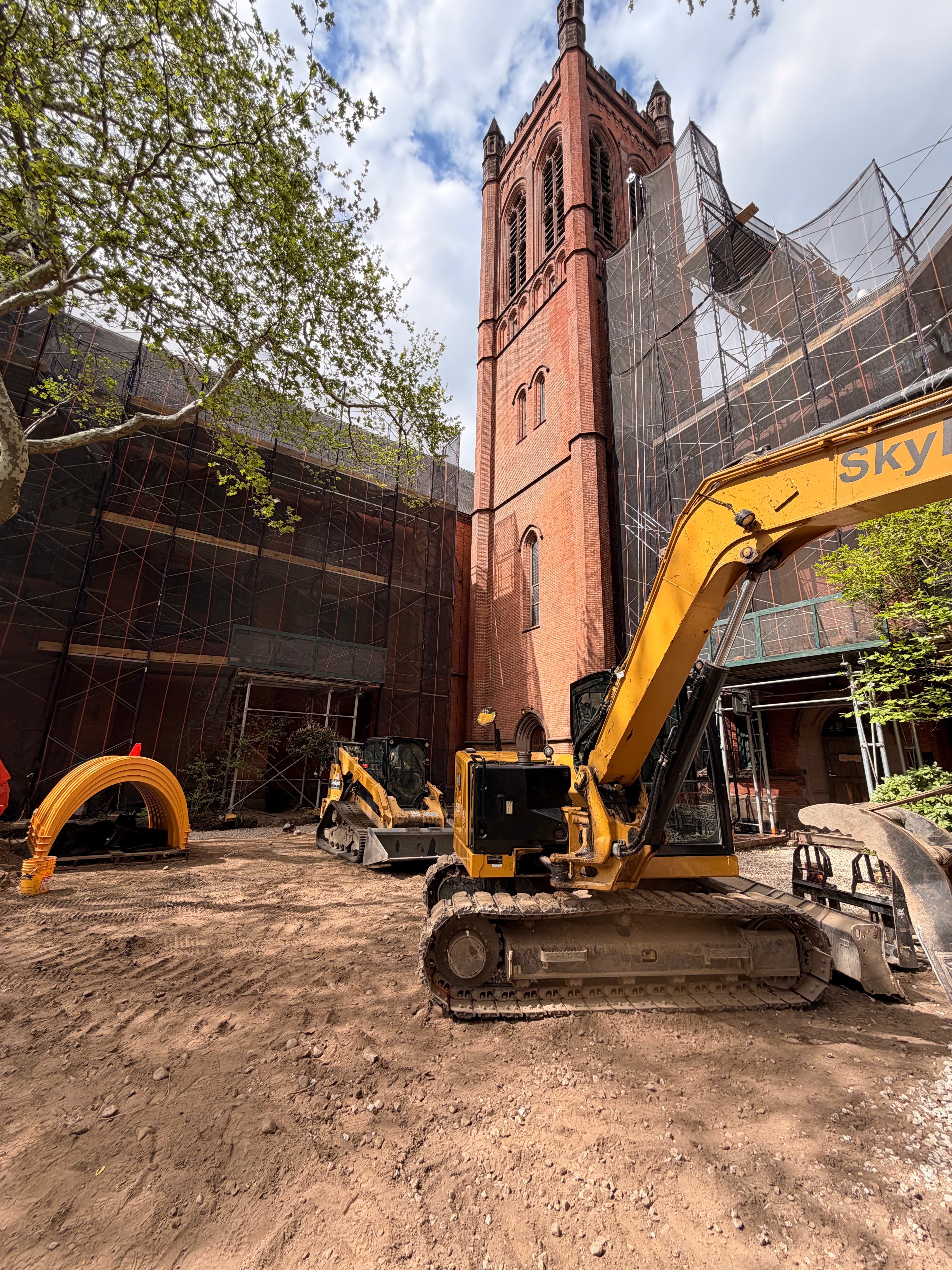
Construction to the east of the Chapel of the Good Shepherd
But this past semester, while teaching a course on the theology of Rowan Williams, I found myself spending less time with the theological topics I expected — doctrine, politics, imagination, language — and more time immersed in his ascetical theology, especially through Looking East in Winter and his engagement with the Eastern Christian tradition, especially the Phlokalia. In that reading, I encountered something that has quietly transformed the way I think about prayer.
For a long time, I unconsciously imagined prayer primarily as a process of “centering myself,” “clearing my mind,” or “removing distractions.” In practice, this often meant trying — mentally, if not physically — to extricate myself from the world.
But the Christian story moves in precisely the opposite direction.
The Incarnation is not God escaping the world but entering ever more deeply into it. Williams once observed that if you step into the waters of the Jordan, you are going to kick up some mud. The Kingdom of God is not about fleeing creation but about God’s reign coming to dwell within it: thy kingdom come, thy will be done, on earth as it is in heaven.
If that is our theology, then perhaps our ascetical practices ought to reflect it.
Praying in a noisy chapel has become, for me, an unexpected spiritual lesson. Rather than expending all our energy trying to tune out the disruption around us, what if we allowed it into the prayer itself? What if the hammer drills and backup beepers joined the song of praise alongside “fire and hail, snow and fog, wind and storm” in the Benedicite? What if, instead of searching for some pristine spiritual enclave untouched by the world, we learned to bring the world with us into prayer?
This does not mean the noise suddenly becomes pleasant. Sometimes one still startles at a crash outside the windows. Sometimes one must strain to hear the preacher over the machinery. But perhaps this, too, is part of the work: learning not to flee embodiment, place, and interruption, but to encounter God precisely there.
I first began learning this lesson years ago from a student — though it hardly feels right to call her that, since she was already a Sister of St. Margaret and one of the most spiritually mature people I have ever known. During an advising-group gathering in my apartment, she led us in a brief centering prayer exercise. At one point, our little dog Poppy click-clacked across the wooden floor, wandered directly into the center of the prayer circle, and began whining for attention.

Poppy in prayer?
I was mortified.
Without missing a beat, the sister simply smiled and thanked God for the sounds of Poppy among us.
Many years later, while learning how to manage anxiety, I encountered something similar in grounding exercises that I still use regularly while living in New York City: becoming attentive to five sounds around me, four visible things, three physical sensations, two smells, one taste. The goal is not to leave the body behind, but to become present within it — to locate oneself honestly within the world God has made.
And perhaps that is part of the invitation this season offers us at General Seminary.
To pray not by fleeing the city, but by loving it. To allow heat, dust, sirens, hammer drills, and human interruption to become companions rather than enemies. To discover that prayer is not the suspension of ordinary life, but its transfiguration.
So for students returning to the Close during this season of construction, for those praying alongside us now, and for future generations who may someday find themselves distracted by sirens, visitors, crying children, or the sheer unpredictability of life in New York City: perhaps the task is not to build a spirituality that hides from the world, but one capacious enough to receive it.
After all, this is the world God created, the world God sustains, and the world God is redeeming.
Love this post, Michael. Right there with you on city noise becoming part of the prayer!