
Theology After Intelligence
The Future of Ministry Isn’t Intelligence. It’s Presence.

A version of this essay was presented at Faithful Futures: Guiding AI with Wisdom and Witness on September 3, 2025
When I first encountered an AI language model in a theological setting, it wasn’t in a classroom or a lab. It was in a meeting of seminary deans in 2022.
One of my colleagues, mostly out of mischief, pulled out his phone and asked ChatGPT to write us a poem. In less than thirty seconds, lines of verse scrolled onto the screen.
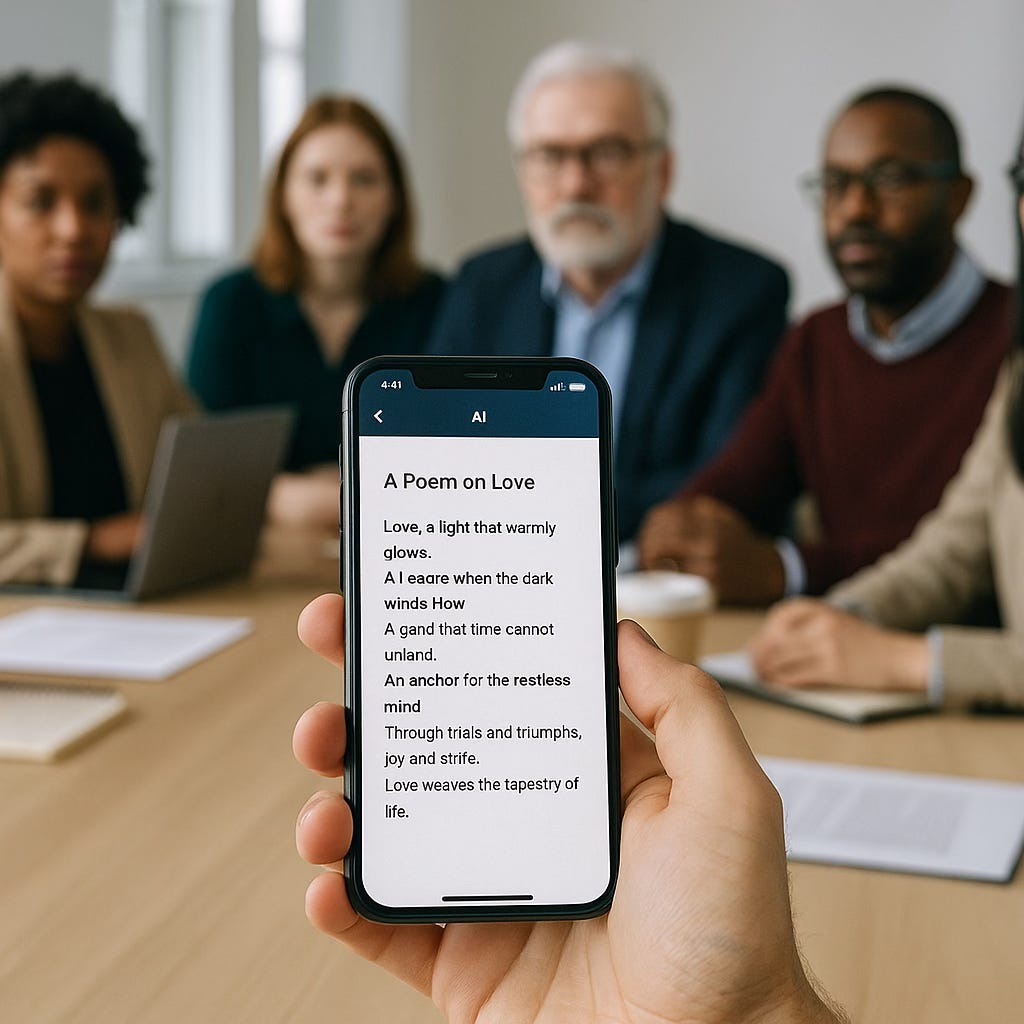
The poem wasn’t profound—it wasn’t Shakespeare—but it was attentive, clever, even a little funny. And then, something happened in the room: Some of my colleagues laughed nervously, others leaned in with curiosity, and a few others shifted in their conference room chairs in discomfort.
It wasn’t just that an algorithm had written a poem, it was that the poem felt like it was written to us. In that moment, we realized something unsettling: a machine could imitate a type of interaction that we had long associated with humanity, creativity, maybe even personhood.
So here’s the question I want to pose:
What happens to theology when the appearance of intelligence is no longer uniquely human?
Technology in the Story of God’s People
Let me begin by stating that the Christian engagement with technologies of information in no way begins with AI. From its very beginnings, the church has used the information technologies of its age for the sake of mission.
Yes, the Word became uniquely flesh in the incarnation of Jesus Christ, but the gospel also became letters carried on Roman roads. It became illuminated manuscripts in monasteries. It became printed books that fueled the Reformation. It became radio sermons, televised revivals, and livestreamed services during the pandemic.
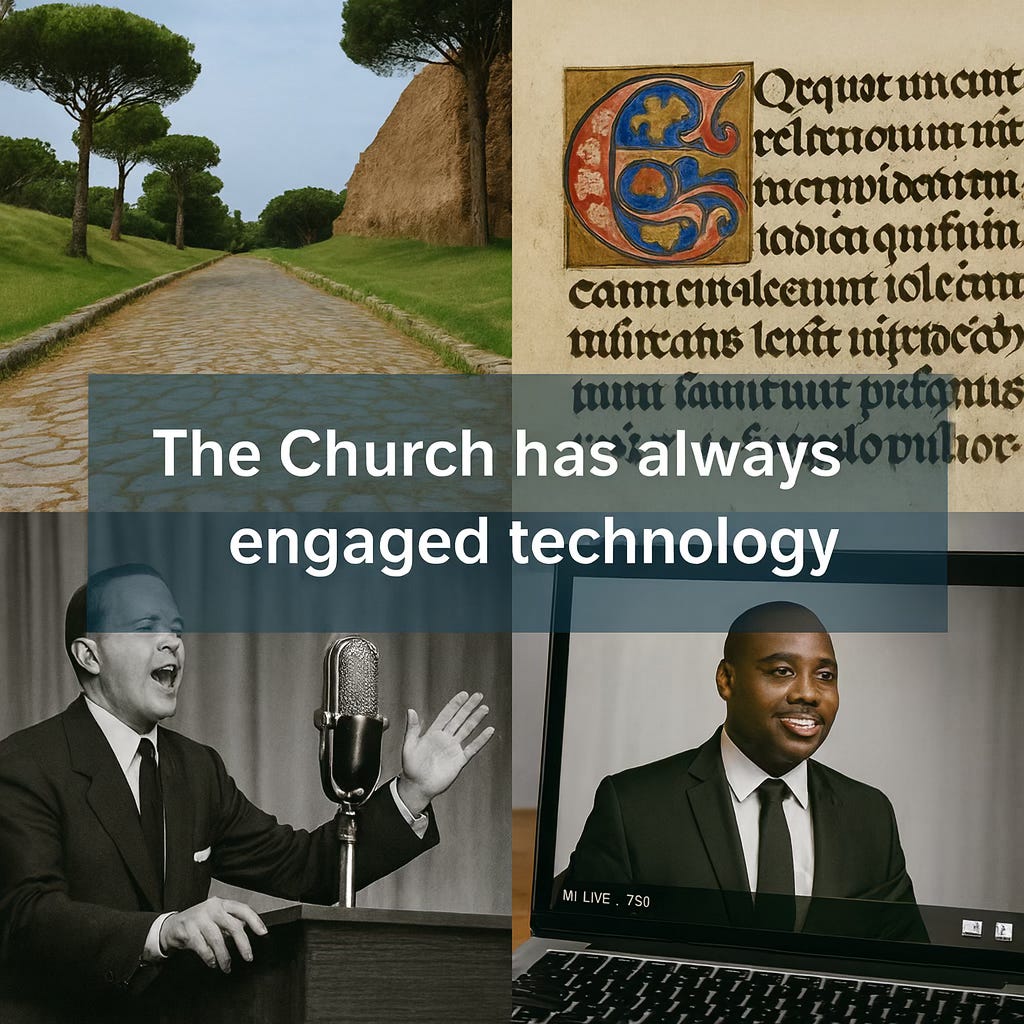
Technology is not foreign to theology. And this should not surprise us, because technology is baked into the story of what it means to be human.
The creation stories of Genesis 1 and 2 describes humanity not as static essence but as vocation — created in God’s image, called to till the garden, name the animals, and shape the earth.
In Genesis 4, following the murder of Abel and before Lamech’s litany, we ready about Cain’s descendants as the originators of human technology and culture: Jabal the nomad, Jubal the musician, Tubal-Cain the smith.
In Genesis 11, humanity learns to fire bricks and build a city and a grand (though ultimately fateful) tower.
In Exodus 31, Bezalel is filled with God’s Spirit to design the tabernacle with wood, stone, bronze, and gold.
Making, crafting, and inventing are not marginal to the human story — they are at the very heart of our vocation as creatures of the sixth day.
And unlike other ANE cultures, in the story of Israel, Technology is not a direct creation of God, it is the creative legacy of humanity, and as these stories point to, it is ambiguous, fallible, capable of both creativity and destruction. And all of this means that the real theological question is never whether technology belongs in God’s world, but how we will use it and what it reveals about us and about God.
The Challenge of AI
I want to suggest that AI - a major innovation in information technology, yet still part of the world of information technology - unsettles us because it presses on our definitions of what it means to be human. Philosophers of technology and authors of science fiction both remind us that technology functions like a mirror. It reflects back to us who we think we are, even as it reframes our understanding of personhood.
And beyond philosophy or fiction, just think about how often we borrow technological metaphors in our own everyday speach when we think of:
The brain as a computer.
Memory as storage.
Relationships as networks.
Intelligence as processing.
This technomorphic language doesn’t just describe reality — it reshapes how we imagine both humanity and machines.

So, when a chatbot speaks in ways that feel human, the mirror shows us the fragility of our own definitions of the human. All of this contributes to what I call thin anthropologies — those that reduce humanity to intelligence, autonomy, or productivity. And these are precisely the ones that collapse under the pressure of AI.
If being human simply means “to think,” then machines that simulate thinking seem to cross the line into being human.
But Christian theology has always offered something thicker.
Thicker Anthropologies
The Hebrew Scriptures speak of humanity as nephesh—living beings, animated dust, body and spirit woven together. The Orthodox tradition describes personhood in Trinitarian terms: to be human is to exist in relation, mirroring the communion of Father, Son, and Spirit. In the 20th century, Wolfhart Pannenberg described the human as exocentric—defined not by inward consciousness but by openness to others. And today, the contributions of feminist and liberation theologians deepen this picture evern further:
Rosemary Radford Ruether placed embodiment and ecology at the heart of theology.
Delores Williams lifted up the survival strategies of Black women under oppression.
Ada María Isasi-Díaz pointed to the practices of solidarity and community as the place where personhood takes shape.
Together, this chorus of voices - ancient and modern - help us dismantle the thin anthropologies that AI tempts us to accept. They remind us that being human means being relational, embodied, justice-oriented, and open to God’s Spirit.
The risk in this age of AI is not that machines will become human, but that we will forget the fullness of what humanity actually is.
Grounded Critical Use
In the book on Technology that I’m writing, I’m trying to articulate a framework for how we can discern technologies (including AI) faithfully I’ve begun to frame this with what I call a Grounded Critical Use Theory of Technology (GCUT). It is grounded because it insists that technology belongs within creation and must be interpreted theologically. It is critical because it acknowledges both the ambiguity of making and the economic and political logics in which technologies are embedded. And it is a use theory because technologies acquire their meaning in practice—through how they are interpreted, received, and embedded within communities of faith.
Five principles guide this:
Using tools is human. From plows to printing presses, tool-making is part of our creatureliness in God’s image.
Tools carry our brokenness. Our sin, biases, and inequities get coded in. AI inherits our failures as much as our brilliance.
Good tools disappear. When we stop noticing them, they shape us most powerfully. Think of how smartphones have changed our sense of time and attention.
Technology shifts vision. Heidegger called technology a “way of revealing.” Don Ihde saw it as “hermeneutic mediation.” Feenberg showed how tools embed power. None of this is neutral.
There is no “virtual.” Behind every chatbot is a server farm burning coal and consuming water. Every bit of computation belongs to creation and carries ecological cost.
GCUT grounds us in creation, critiques power, and attends to how technologies are actually used.
Ministry Beyond Intelligence
So here’s where the theological rubber meets the road of ministry.
If preaching is just “content,” AI will generate it faster.
If pastoral care is just “therapy,” AI companions will provide it more consistently.
If leadership is just “management,” AI will do it more efficiently.
But ministry has never been reducible to content, therapy, or management. Ministry is embodied presence, sacramental life, discipleship in community, solidarity with the vulnerable.


So what does ministry look like in the light of AI? Preaching may be assisted by algorithms that generate outlines or draft sermons, but preaching has never been mere content delivery; it is dialogue with God and with the congregation, born from prayer, wrestling with Scripture, and discerning the Spirit for a particular people in a particular place. My fear with an over reliance on an LLM for a sermon has less to do with the quality of the sermon than it does with the cost to the preacher who misses an opportunity to wrestle with God in prayer and study.
Pastoral care, too, will inevitably encounter chatbots at 3 a.m., but the heart of care has never been clever words — it is embodied presence, the act of sitting at a bedside, sharing silence, and bearing witness in flesh and blood.
And when it comes to justice, AI is already reshaping economies in ways that threaten especially white-collar work, exposing how deeply church life has been shaped by white-collar assumptions. If we allow our vision of humanity to shrink into consumers rather than makers, AI will only accelerate that reduction. In this moment, the church is called to reclaim its vocation to stand alongside those displaced, excluded, or made invisible by these technological shifts.
The Future of Ministry
In view of this call for both a Grounded Critical Use Theory of Technology and in keeping with the thicker anthropologies of the Church, I want to suggest that the future of ministry is not intelligence. The future of ministry is presence.
And in that sense, AI may even be a gift. It can remind us what it means to be human:
Not isolated thinkers, but embodied creatures of the sixth day.
Not autonomous minds, but beings made for communion.
Not consumers of content, but people called into practices of presence, solidarity, and justice.
If we use these tools well—not to mirror our thinnest notions of humanity but to serve human flourishing, justice, and communion—then AI will not hollow out our ministries. It will help us remember who we are.
That is the theological task before us: to use these tools critically, faithfully, and hopefully, for the sake of deeper humanity in Christ.
The intriguing thing about your comment (well, one of them) is how the human-to-AI dynamic (AI as a reflection of human capacities) mirrors the way many theologians understand the imago Dei (human beings as a reflection of divine attributes). It’s almost an inversion of Freud’s critique of religion as wish-fulfillment or projection. Instead of saying we imagine God as a person because we are persons, Christian theology suggests the opposite: we are persons because God is personal — or perhaps better, suprapersonal.
This comes into sharper focus within Trinitarian theology: God is three persons in one essence, whereas human beings are one essence, one person. From that perspective, one of the clearest ways humans bear the divine image may be in our capacity to create other “persons” — beings who instantiate personhood differently than we do. A divine person, a human person, and (if we stretch the category this far) an AI “person” would all express personhood in distinct modes of embodiment.
It’s not quite Neo-Platonic emanation. It’s more like a child learning a craft from a parent — say, a young girl in the kitchen with her mother, playing with scraps of dough while her mother bakes a pie. The child’s pie is recognizably pie-like, but not of the same quality or origin as the original.
Excellent Substack! I am really looking forward to your book! I used this SS as the basis for a reflection I gave this morning at work.